Trading Trader Stocks Equities Options Futures Rules Tips Lessons Education Psychology NASDAQ NYSE GLOBEX Global Macroeconomics
Search This Blog
Thursday, December 22, 2016
Speculation as a Fine Art by Dickson G. Watts
Reminiscences of a Stock Operator the book about Jesse Livermore written by Edwin Lefèvre constantly references Speculation As A Fine Art by Dickson G. Watts, written in the 1880s. Livermore is quoted as saying that Watts "wrote the book on speculation."
I base my trading approach upon many of these simple ideals. The truth about markets and how to look at them is quite simple. Don't make it complicated.
Here some excerpts from the book:
1. Self-Reliance. A man must think for himself,
must follow his own convictions. George
MacDonald says: "A man cannot have another
man's ideas any more than he can another
man's soul or another man's body." Self-trust
is the foundation of successful effort.
2. Judgment. That equipoise, that nice
adjustment of the faculties one to the other,
which is called good judgment, is an essential
to the speculator.
3. Courage. That is, confidence to act on the
decisions of the mind. In speculation there is
value in Mirabeau's dictum: "Be bold, still be
bold; always be bold."
4. Prudence. The power of measuring the
danger, together with a certain alertness and
watchfulness, is very important. There should be
a balance of these two, Prudence and Courage;
Prudence in contemplation, Courage in execution.
Lord Bacon says: "In meditation all dangers
should be seen; in execution one, unless very formidable."
Connected with these qualities,
properly an outgrowth of them, is a third, viz:
promptness. The mind convinced, the act should
follow. In the words of Macbeth; "Henceforth the
very firstlings of my heart shall be the firstlings
of my hand." Think, act, promptly.
5. Pliability the ability to change an opinion,
the power of revision. "He who observes,"
says Emerson, "and observes again, is always
formidable."
The qualifications named are necessary to the
makeup of a speculator, but they must be in well-balanced
combination. A deficiency or an overplus of one
quality will destroy the effectiveness of all. The possession
of such faculties, in a proper adjustment is, of
course, uncommon. In speculation, as in life, few succeed,
many fail
LAWS ABSOLUTE.
1. Never Overtrade. To take an interest larger than
the capital justifies is to invite disaster. With such an
interest a fluctuation in the market unnerves the
operator, and his judgment becomes worthless.
2. Never "Double Up"; that is, never completely and
at once reverse a position. Being "long," for instance,
do not "sell out" and go as much "short." This may
occasionally succeed, but is very hazardous, for should
the market begin again to advance, the mind reverts
to its original opinion and the speculator "covers up"
and "goes long" again. Should this last change be
wrong, complete demoralization ensues. The change
in the original position should have been made moderately,
cautiously, thus keeping the judgment clear
and preserving the balance of the mind.
3. "Run Quickly," or not at all; that is to say, act
promptly at the first approach of danger, but failing
to do this until others see the danger, hold on or close
out part of the "interest."
4. Another rule is, when doubtful, reduce the amount
of the interest; for either the mind is not satisfied with
the position taken, or the interest is too large for
[10]safety. One man told another that he could not sleep
on account of his position in the market; his friend
judiciously and laconically replied: "Sell down to a
sleeping point."
RULES CONDITIONAL.
These rules are subject to modification according
to the circumstances, individuality and temperament
of the operator.
1. It is better to "average up" than to "average down."
This opinion is contrary to the one commonly held
and acted upon; it being the practice to buy, and on a
decline to buy more. This reduces the average.
Probably four times out of five this method will result
in striking a reaction in the market that will prevent
loss, but the fifth time, meeting with a permanently
declining market, the operator loses his head and
closes out, making a heavy loss - a loss so great as to
bring complete demoralization, often ruin.
But buying at first moderately, and, as the market
advances, adding slowly and cautiously to the "line"
- this is a way of speculating that requires great care
and watchfulness, for the market will often (probably
four times out of five) react to the point of "average."
Here lies the danger. Failure to close out at the point of
average destroys the safety of the whole operation.
Occasionally a permanently advancing market is met
with and a big profit secured.
In such an operation the original risk is small, the
danger at no time great, and when successful, the
profit is large. The method should only be employed
when an important advance or decline is expected,
and with a moderate capital can be undertaken with
comparative safety.
2. To "buy down" requires a long purse and a
strong nerve, and ruin often overtakes those who have
both nerve and money. The stronger the nerve the
more probability of staying too long. There is, however,
a class of successful operators who "buy down"
and hold on. They deal in relatively small amounts.
Entering the market prudently with the determination
of holding on for a long period, they are not
disturbed by its fluctuations. They are men of good
judgment, who buy in times of depression to hold for
a general revival of business - an investing rather than
a speculating class.(I buy down when I am swing trading)
3. In all ordinary circumstances our advice would
be to buy at once an amount that is within the
proper limits of capital, etc., "selling out" at a loss or
profit, according to judgment. The rule is to stop losses
and let profits run. If small profits are taken, then small
losses must be taken. Not to have the courage to accept
a loss, and to be too eager to take a profit, is fatal. It
is the ruin of many.
4. Public opinion is not to be ignored. A strong
speculative current is for the time being overwhelming,
and should be closely watched. The rule is, to act
cautiously with public opinion; against it, boldly. To
go with the market, even when the basis is a good one,
is dangerous. It may at any time turn and rend you.
Every speculator knows the danger of too much "company."
It is equally necessary to exercise common
caution in going against the market. This caution
should be continued to the point of wavering - of loss
of confidence - when the market should be boldly
encountered to the full extent of strength, nerve and
capital. The market has a pulse on which the hand of
the operator should be placed as that of the physician
on the wrist of the patient. This pulse-beat must be
the guide when and how to act.
5. Quiet, weak markets are good markets to sell. They
ordinarily develop into declining markets. But when a
market has gone through the stages of quiet and weak to
active and declining, then on to semi-panic or panic, it
should be bought freely. When vice versa, a quiet and
firm market develops into activity and strength, then
into excitement, it should be sold with great confidence.
(This rule is the least applicable to my trading)
6. In forming an opinion of the market, the element
of chance ought not be omitted. There is a
doctrine of chances - Napoleon in his campaigns
allowed a margin for chance - for the accidents that
come in to destroy or modify the best calculation.
Calculation must measure the incalculable. In the
"reproof of chance lies the true proof of men."
It is better to act on general than special information
(it is not so misleading), viz., the state of the country,
the condition of the crops, manufacturers, etc. Statistics
are valuable, hut they must be kept subordinate to a comprehensive
view of the whole situation. Those who
confine themselves too closely to statistics are poor
guides. "There is nothing," said Canning, "so fallacious
as facts, except figures."
"When in doubt, do nothing. Don't enter the market
on half convictions; wait till the convictions are fully
matured."
Tuesday, July 19, 2016
30 Trading Rules by Tyler Bollhorn
My added rules in red.
1. Buying a weak stock is like betting on a slow horse. It is retarded.
(Shorting a strong stock is like betting on a slower horse. It is more retarded.)
2. Stocks are only cheap if they are going higher after you buy them.
3. Never trust a person more than the market. People lie, the market does not.
4. Controlling losers is a must; let your winners run out of control.
(Hang on to a partial position with a stop to increase profits)
5. Simplicity in trading demonstrates wisdom.Complexity is the sign of inexperience.
(Less is more in trading)
6. Have loyalty to your family, your dog, your team. Have no loyalty to your stocks.
7. Emotional traders want to give the disciplined their money.
(Study self-control of emotions and mindfullness. Meditation helps)
8. Trends have counter trends to shake the weak hands out of the market.
9. The market is usually efficient and can not be beat. Exploit inefficiencies.
10. To beat the market, you must have an edge.
(FOCUS on your edge(s), i.e. ideal trading setups/situations)
11. Being wrong is a necessary part of trading profitably. Admit when you are wrong.
12. If you do what everyone is doing you will be average, so goes the definition.
13. Information is only valuable if no one knows about it.
(99% of the time within seconds to minutes almost ALL information has been factored into price)
14. Lower your risk till you sleep like a baby.
(Understand bigger trends before taking size positions overnight)
15. There is always a reason why stocks go up or down, we usually only learn the reason when it is too late.
(Searching for a reason will likely cost you some/all profit)
16. Trades that make a lot of intellectual sense are likely to be losers.
17. You do not have to be right more than you are wrong to make money in the market.
18. Don’t worry about the trades that you miss, there will always be another.
19. Fear is more powerful than greed and so down trends are sharper than up trends.
(The greatest losses occur because you don't act soon enough)
20. Analyze the people, not the stock.
(Analyze the reaction of the news, not the news itself)
21. Trading is a dictators game; you can not trade by committee.
22. The best traders are the ones who do not care about the money.
23. Do not think you are smarter than the market, you are not.
24. For most traders, profits are short term loans from the market.
25. The stock market can not be predicted, we can only play the probabilities.
26. The farther price is from a linear trend, the more likely it is to correct.
27. Learn from your losses, you paid for them.
28. The market is cruel, it gives the test first and the lesson afterward.
29. Trading is simple but it is not easy.
30. The easiest time to make money is when there is a trend.
(Your best trades should always be identified at the beginning of the trend)
© 1 Trader and jcspe85.blog.com, 2016
Thursday, March 17, 2016
Napolean Hill's 30 Major Causes of Failure and How They Relate to a Trader
Think and Grow Rich was written in 1937 by Napoleon Hill. What I have found most helpful in relation to trading are his "30 Major Causes of Failure". I have added questions which relate to being a trader. I personally write notes to myself about my daily mistakes. And I think about these questions so I can identify the content of my notes.
1. Unfavorable hereditary background.
2. Lack of a well-defined purpose in life. Do you have desire and focus every day you trade?
3. Lack of ambition to aim above mediocrity. Do you learn by finding the answers yourself?
4. Insufficient education. Have you done adequate paper trading? Are you aware of the importance of trader psychology?
5. Lack of self-discipline. Are you able to self-correct mistakes?
6. Ill health. Are you 100% alert? Are you hungover?
7. Unfavorable environmental influences during childhood.
8. Procrastination. Do you delay making changes?
9. Lack of persistence.
10. Negative personality.
11. Lack of controlled sexual urge. LOL
12. Uncontrolled desire for “something for nothing”.
13. Lack of a well defined power of decision. Do you reach decisions promptly? Can you take losses without hesitation? Can you reverse your opinion in a split second?
14. One or more of the six basic fears. (fear of poverty, criticism, ill health, loss of love, old age, and death) Do you fear the opinions of others?
15. Wrong selection of a mate in marriage.
16. Over-caution. Are you comfortable with risk?
17. Wrong selection of associates in business.
18. Superstition and prejudice.
19. Wrong selection of a vocation. If trading makes you ill or unhappy, don't do it.
20. Lack of concentration of effort. Have you eliminated your distractions?
21. The habit of indiscriminate spending.
22. Lack of enthusiasm.
23. Intolerance.
24. Intemperance.
25. Inability to cooperate with others.
26. Possession of power that was not acquired through self-effort.
27. Intentional dishonesty.
28. Egotism and vanity. Do you feel a need to feed your ego?
29. Guessing instead of thinking.
30. Lack of capital.
Wednesday, June 10, 2015
Shorting Gapped-Up stocks before/after the open
Before shorting gapped up stocks at the open, you should already be familiar with day trading short.
Here are considerations when shorting stocks that gap up Pre-Market:
There needs to be signifigant volume Pre-Market or AH the prior day for a gapped up, short trade to potentially work. In other words, the catalyst has to force a squeeze of existing shorts and/or create buying panic.
Pre-market direction is difficult to judge. 90% of the time I close or reduce my pre-mkt short trade before the open and then re-short after the open(even if I get filled at a worst price).
If you are unfamiliar or uncomfortable with thin, pre-market trading conditions, then don't trade short during pre-market.
Reduce trading size until you are consistent.
Intraday volatility is normally highest at the open. Spreads become wide. So, you must allow for wiggle room. And if you are wrong, i.e. squeezed, expect to lose more money than usual.
Always scale-in. Increase exposure upon confirmation. On some trades, confirmation usually occurs when the opening range is broken. Realize there will be many sell orders, likely market orders, following the break of the opening range. On other trades, initial shorts are squeezed to a higher price before the actual stock price decline begins.
Level of shorting difficulty for gapped up stocks, from most difficult to least difficult: momentum based, earnings beat, news and analyst upgrades.
Momentum based shorts which move due to popularity, for ex. Ebola stocks or body camera stocks, are difficult to short if the float has been traded several times over during the previous day. Other recent stocks which fall into this category include PBMD and VLTC. Avoid shorting these stocks until you have an advanced ability in market timing. Better to trade these stocks on the long side.
Stocks which gap up due to strong earnings will potentially be a long trade after a morning decline, particularly if the stock is trading at new highs.
Wednesday, May 06, 2015
excellent article on Revenge Trading: Trying to Recover Losses Back
Before you read this... realize this information pertains more to beginning-intermediate traders. Stocks like $PTBI $VLTC $ICLD, which I recently traded, have difficult to spot trends/pivot points. Plus, when the float is traded 2X, 3X or more in one day, there is a high likelihood of being squeezed if you are short. Until you have a built up mental resistance to drawdowns along with trading experience, these trades should be done with reduced size or possibly not done at all.
No reason to cut your teeth in trading difficult stocks or difficult strategies.
When I do tweet a trade in this type of stock, it is likely that I have found a better (for lack of correct adjective) entry point to short. So I will tweet the trade. However, the risk to get squeezed is still there.
Remember, some traders, usually ones with greater experience, ability and deeper pockets, can turn around the next day from a loss and trade at 100%, with a clear mind. However, this ability is not something that can be attained easily, likely not in the first year or two of trading. Most traders should recoup from the psychological damage from a large loss before continuing trading. I recommend reducing trade size or taking a break first, if you are not an advanced trader.
=======================================================
The article below is written about the 'angry trade' but even if you are not angry, the same scenario and outcome could result due to your damaged mental state.
From http://www.financial-spread-betting.com/strategies/revenge-trading.html
The ‘angry trade’ is the worst possible trade you can make. It’s usually done after a loss with a desire to get your own back, or more specifically to win back the money you’ve just lost.
There are several reasons it’s so bad:
1) It’s often not planned out properly. Whereas your first trade may have been carefully planned and may actually have been a sensible trade that just went wrong, more often than not the trade following it is an unplanned one that’s done in a hurry. More often than not it’s no better than gambling. You do it in such a hurry to win back your losses that you haven’t properly considered exit points and analysed the risk.
2) Quite often it’s a larger bet than the first one because you’re so desperate to win back what you’ve just lost that you want to do this as quickly as possible. And the quickest way to do this (according to your logic at the time) is to raise your stake size. Again, you’ve completely ignored the risk.
3) It’s an emotional trade that’s done for the wrong reasons. Your emotions have so overcome your normal rational decision making process that it’s quite likely that you’ve not factored in all sorts of other potential pitfalls (e.g. long-term support or resistance that you might be trading against).
The problem with the angry trade is that it often starts off a spiral. If it wins great, but the problem here is you’ve effectively won by gambling, and you might try to repeat that win by gambling again, without using anything more than gut instinct. This goes against all the rules of trading and will result in you eventually blowing your account. If it loses, as it’s more likely to do, then you’ve effectively dug yourself even deeper into the hole you were just in. This then results in an even angrier trade, and so on, leading to desperation and seriously increasing the chances of blowing everything in a short space of time.
Ask yourself, what caused this angry trade in the first place? Why were you so desperate to win back what you’d just lost?
The chances are that, although the first trade may have been a good one that didn’t work out, you hadn’t correctly mentally accepted the risk before you went into the trade. You may also have been trading too large a stake. A good technique is, before placing a trade, to always assume that it’s going to be a loser. Work out your risk this way. How much are you willing to lose on the trade? You need to see it in the long term perspective as a proportion of the capital that you’ve set aside for trading. This way, if it does lose, you’ll be ready for it. You will only have lost a small proportion of your capital (it shouldn’t really be any more than 2%) and you’ll better be able to deal with it. Then you simply have to try to forget about it. Do not let it affect your next trade. This is the hardest part and what divides the winners from the losers. If necessary, take some time out for example, don’t trade for another 24 hours – until you’re convinced that you’re in an unemotional state of mind that will make sure that your next trade isn’t an angry one – ie that it’s taking advantage of a beneficial opportunity (not just trading for the sake of it), that it’s properly planned out, and that you’ve properly calculated your stake size based on your risk limits.
This is another of those incredibly important lessons that you’ll do well to heed. Just remember, next time you have a loss, just stop. Accept that the money’s gone and that the next trade you make will be on its own merits, completely unconnected from the last one. This way and this way only will you progress from being a loser to being a winner.
Monday, April 20, 2015
Book Review of Pit Bull, Lessons from WALL STREET'S Champion Trader
(all quotes from the book are in BOLD)
There are many rudimentary points mentioned in this book which are invaluable to any trader. Martin "Buzzy" Schwartz has given thorough details about his trading life. Also, he has given much insight into the reasons for his losing and winning trades. I will summarize information which I have found helpful. This is a book which should be read many times during a trader's career, especially if you have suffered a setback.
Martin always wanted to be a trader. His wife of 4 months, Audrey, told him to become a trader at age 33.
Martin was good at math, loved gambling and the market. He wrote down BECOME A TRADER. (his goal)
He then wrote a plan DEVELOP A METHODOLOGY FOR TRADING THAT FITS MY STYLE.
ACCUMULATE A GRUBSTAKE OF $100,000.
He set a time frame WITHIN ONE YEAR
He needed a mentor MAKE ZOELLNER MY MENTOR.
GET A SEAT ON SOME EXCHANGE.
TAKE A SABBATICAL.
He started trading Call options. He broke even the first two years. And then began making consistent money.
YOU HAVE TO PROVE YOUR ABILITIES AND TEST YOUR METHODS BY ACTUALLY TRADING, AND MAKING REAL MONEY, BEFORE YOU DEPEND ON TRADING FOR YOUR LIVELIHOOD
He borrowed $50,000 after saving $50,000 for his grubstake.
He was a securities analyst for 9.5 years before he quit to become a trader.
What he learned from playing craps:
DIVORCE YOUR EGO FROM THE GAME
MANAGE YOUR MONEY
CHANGE TABLES AFTER A WINNING STREAK (periodically deposit your winnings)
...mental discipline may not make you a winner in the market , but if you don't have it, you're sure to be a loser.
In 1981 he made $1.2 million trading options in mainly one stock, ASA.
In 1982, he began trading S&P futures. His trading edge for trading S&P futures was by watching bond futures.
At age 37, he became a multimillionaire.
Luck? You bet it was luck. but it was also intellectual because I worked so hard at it.
Going short's a game for the pros.
He lost $800,000 on a short S&P futures trade. But ended down only $57,000 for the same month.
...thanks to Audrey and Zoellner (his mentor), I'd realized my mistake and got beyond it.
The best way to end a losing streak is to cut your losses and divorce your ego from the game.
Stop trading, take time to recover and start trading small.
...concentrate on being profitable. DON'T START BY TRYING TO MAKE A KILLING.
CONFIDENCE IS ESSENTIAL TO A SUCCESSFUL TRADER.
Losing streaks are an unfortunate part of the game, but if you are a good disciplined trader who can shift into neutral, the losing will end and black ink will start to flow again.
He won the U.S. Investing Championships in 1983 with a 175.3 percent return. Over a 4 month period he parlayed his $482,000 stake into $1.2 million. In the next contest he posted a 443.7 percent return, beating 262 entrants.
One of the great tools of trading is the stop, the point at which you divorce yourself from your emotions and ego and admit that you're wrong.
EXITING A LOSING TRADE QUICKLY CLEARS YOUR HEAD AND RESTORES YOUR OBJECTIVITY.
By preserving your capital through the use of a stop, you make it possible to wait for a high-probability trade with a low-risk entry point.
According to his friend Mark Cook:
to be a successful trader you have to have a complete commitment to trading and do it full-time.
...fit your trading habits to your personality. Know you emotional weaknesses
...planning is the objective part of trading.
You have to have natural skills, but you have to train yourself on how to use them.
Break the pressure before it breaks you.
WHEN YOU'RE IN A LOSING POSITION AND YOU'RE BRAINLOCKED, DO WHATEVER'S NECESSARY TO HELP CLEAR YOUR HEAD.
I've learned through the years that after a good run of profits in the markets, it's very important to take a few days off as a reward.
KEEP YOUR BALANCE.
Hard work is the primary reason why I've become so successful, but hard work's just part of the equation. By nature, I'm a gambler with a good feel for numbers, and , as I've mentioned before, Amherst taught me how to think, Columbia Business School taught me what to think about, the Marine Corps taught me how to perform under fire, and Audrey taught me the importance of money management.
Listening to what the market is saying takes extreme concentration.
There is an entire chapter titled "The Pit Bull's Guide to Successful Trading." I recommend reading it.
... the most important change in my trading career occurred when I learned to DIVORCE MY EGO FROM THE TRADE. Trading is a psychological game.
You have to stop trying to will things to happen in order to prove you're right. Listen to what the market is telling you now. Forget what you thought it was telling you five minutes ago.
What I like most about this book is that Martin Schwartz did not need to write this book for the money. I have read short interviews about traders. But this book hits home because it details the entire journey of a highly successful trader, one of the Market Wizards.
1trader
Thursday, April 02, 2015
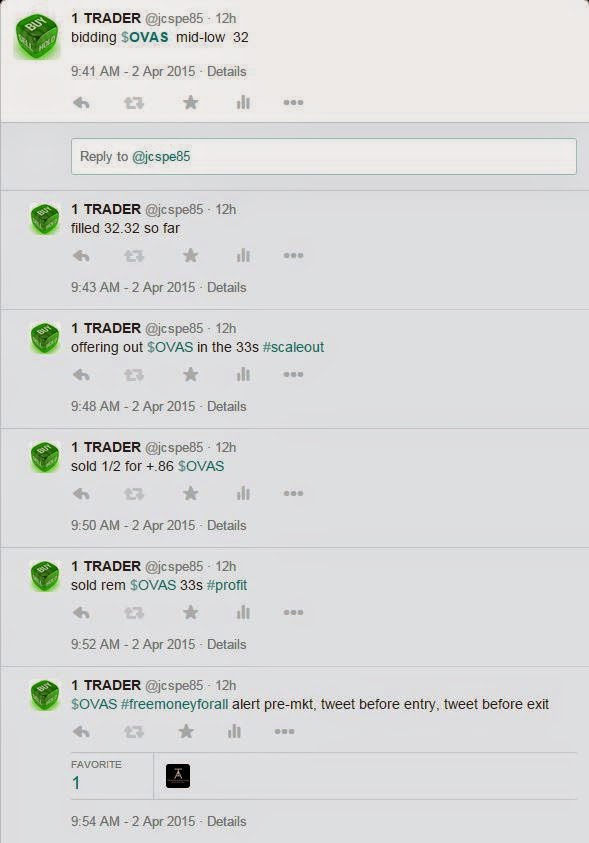
The Art Of The Trade OVAS April 2 2015
How I traded $OVAS today
Time is for tweets in EST. Highlighted tweets were tweeted prior to activity.
9:16 $OVAS #watch long (identified stock as long trade pre-mkt)
9:19 noted pre-mkt volume as 175 shares total (very weak)
9:32 bid for stock, bought 32.46 avg (no tweet)
9:37 scalped 1.19 $OVAS #profit (sold 33.27 avg)
9:41 bidding $OVAS mid-low 32 (before the entry)
9:43 filled 32.32 so far (initial buy trade)
9:48 offering out $OVAS in the 33s #scaleout (before the exit)
9:50 sold 1/2 for +.86 $OVAS
9:52 sold rem $OVAS 33s #profit
10:00 bid for $OVAS mid 32s again (no tweet)
10:58 $OVAS vol getting thin... out of last long scalp now 33.5s
(sold for 1.04 avg 3rd trade)
11:17 will wait for $OVAS to pb closer to 33 before buy #swing
(stock was trading 34s but identified potential for PB)
11:33 went long at new hod but exited trade for small scalp (no tweet)
11:41 stock fails to recover after breaking below area after new highs (no tweet)
11:43 for next 10 minutes, shorted stock 33.9s (no tweet)
12:22 stock hits 33 and I begin to cover +.91, also going long as noted before on 11:17 tweet (no tweet)
1:18 $OVAS up it goes
1:57 sold all $OVAS from 33 #profit (filled 34.7s - 34.8s)
2:05 +1.81 avg on all $OVAS (prev trade profits)
2:09 stock trades new hod, I buy back small, 35 avg, observed heavy buying (no tweet)
2:14 $OVAS long sm sz fwiw at 35
2:15 $OVAS will offer 35.4+ to sell (tweet before exit)
2:17 sold 35.4s for .42 (no tweet)
2:18 noticed extreme chop in stock, did smaller sz trades for next hour
very choppy channel trading (no tweet)
2:46 Will buy and hold $OVAS for #swing before eod (wanted to re-buy
when day traders exit, thinking possible break below 35)
3:20 sell stops hit at 35, bids drop for the next 3 minutes, large prints
hit the tape at 3:23, observed bid holding 34.60 so I entered trades (no tweet)
3:35 long 10k $OVAS 34.62 avg ST #swing
NOTE: MACD is just a guide. This indicator is based on trailing data. Thus MACD trend lines displayed are not to be interpreted as a leading indicators. I only use MACD in hindsight to confirm what I saw on the tape.
Saturday, March 21, 2015
Twittertainment vs Reality, the true trolls of Twitter
https://www.sec.gov/litigation/litreleases/2009/lr21053.htm
Nathan Michaud @investorslive investigated by the SEC for penny stock manipulation. investorsunderground.com investors underground investorslive nathanmichaud.com
https://www.goodetrades.com/2012/01/penny-stock-trader-nate-michaud-settles-with-sec-in-pump-dump-case/
" I do believe that he is guilty of impropriety in the case he settled with the SEC" - Michael Goode @goodetrades
http://lasvegassun.com/news/2009/may/21/sec-las-vegas-companys-stock-manipulated-profits/
"Nathan M. Michaud of Boston, said to be a web site designer."
My use of Twitter is a combination of 99% business and 1% entertainment . I created the @jcspe85 Twitter account to detail my daily trading thoughts and activities. My trades are not to be taken as recommendations. However, my trade selection and my trading process are meant to show how someone with >30 years of trading experience, most as a professional trader with FINRA licenses, goes about the daily business of trading stocks, options and futures.
My twitter feeds and this blog are 100% FREE. I don't get compensated by Google Ad Sense for this blog, so I don't receive advertising money. I recommend books but I have no links to Amazon, so no money from referrals.
In the trading world, worthwhile help is unheard of... especially if it is free. I am thankful for some of the information provided by people in the Twitter trader community. Much of my research time is shortened because I find my answers on Twitter. My trading business requires at least 10 hours a day to do properly. So, during most days, I don't have time to respond to questions right away. And I am limited to how I much I can answer via Twitter's direct messaging system. Recently I have taken about an hour each day to respond to DM questions during After Hours, a total of 20-25 hours per month. Many people have asked me to be their trading mentor but I simply cannot do it at the moment because of time constraints. Just like any other trader, I need down time to relax, exercise and refocus, not to mention to have a personal life. I love trading but trading can become a disaster if you allow it to consume your life.
I am a proponent of paid trading services such as chat rooms, courses and coaching sessions. Its far better and cheaper to learn from experienced traders than to lose money making your own mistakes. I was lucky to have a professional trading career to pay for some of my education. I have used paid subscription services in the past. But mostly, my learning came from books and on-the-job training.
As noted in a prior blog post, I have intentions of providing paid services, one day.
This leads me to the reason I am composing this blog today, Twittertainment vs Reality. I enjoy the entertainment of jokes and photos and what not from other Twitter folks. It breaks up the monotony during the down time of the day. My tweets are about actionable trades. So I leave the Twittertainment to others.
The reality of Twitter is that the more famous you become, the more the trolls come after you. Accordingly, I have had to post a Twitter policy to let followers know my zero tolerance policy of trolling. I have and will curtail all trolling activity towards me by an immediate block. Its not a reflection of who I am BUT I cannot allow the shenanigans of haters to affect my mood, and even more so, my trading performance. Its hard to distinguish the haters from the good people sometimes. So if I accidentally blocked you, then email me or comment on this post for an unblock.
If you have been following my Twitter feed this week, you may have noticed that several ex-followers(I blocked all I could find) on Twitter, many associated with Investors Underground chat, have decided to slander and ridicule me on Twitter, beyond normal jokes or occasional sarcasm. For the most part I have ignored unruly and childish people. Its not my nature to reply to haters, but some of these individuals I have helped numerous times with trading questions, especially @Modern_Rock, the biggest cheerleader of Investors Underground chat. I don't know MR's real name and we have never met in person.
At 1:17 a.m. Thursday morning I created a new blog post, 10 Strict Guidelines For Traders, while trading futures. Realize I was doing something to help traders who read my blog AFTER midnight. I edited the content of a trading related article I read on the internet. I customized the content to reflect my interpretation of day trading. Most of the information on the article was spot on, but I added the most important concept in guideline no. 10. Also, I removed numerous, impertinent sentences and paragraphs. All in all, less than half of the article was used. I released it to the public without proofreading in entirety. I always re-edit blogs after I post anyway and had intended to look over it the next chance I got. It was late, I set my stops on my futures trades and went to sleep at 1:20 a.m.
Later, Thursday morning, about 1-hour prior to market open, @Nikkorico_ of IU chat tweeted to me about not posting the editorial credit for the article. It took me less than a minute to update with a credit reference to my blog post. I had previously referenced material on this blog before. My blog posts are not being quoted, nor published for profit, nor used to attract paying subscribers. Why should this be of any concern, regarding a free blog post, for anyone to alert me via Twitter? But then several other, new IU chat members replied to @Nikkorico_ 's tweet. For the most part I thought these actions were odd. Why didn't @Nikkorico_ email me or just comment on my blog? I have never conversed with @Nikkorico_ before. He could have used the email contact for this blog or have commented at the bottom of the post. Minutes later @InvestorsLive joined the conversation. I have never met anyone in person from IU chat, nor do I know @InvestorsLive, Nathan Michaud, founder of IU chat. Nathan had tweeted me once before, but he doesn't follow me. I received over 10 tweets in a span of 30 minutes before the market open. Incidentally, their troll tweets were deleted in order to hide the evidence.
The trolling attack continued throughout the day. A few trolls I had blocked from the past also joined in. I blocked more than 30 people that day.
The following day, Friday, more trolls, including @michiganwar @PsychoOnWallST @parabol128 @swedepilot, decided to pick on my Twitter-related Instagram account. I created @jcspe85 in February 2015 to generate awareness of my Twitter account and blog. More IU chat members and @Nikkorico_ and @Modern_Rock re-tweeted the same tweets. @jcspe85 is/was not my personal Instagram account. How do photos of what I drive, what I eat, where I travel to, lend credibility to my trading aptitude? Trading profits have rewarded me well. I deleted the Instagram account and blocked more trolls.
It is obvious certain IU members felt threatened by my growing popularity on Twitter. Perhaps now my popularity is at a point where Nathan Michaud felt I would encroach on his subscription service. I don't charge a cent and I provide actionable and helpful content on Twitter. I must be considered to be a business threat by Nathan Michaud.
Nathan Michaud is a hypocrite.
In summary, I want everyone to be aware of this unscrupulous activity. The lies and exaggerations that were made to discredit me failed. But if it does get worse, I will contact my attorney in regards to a defamation lawsuit. For the record, I have saved their deleted tweets via Tweetcaster, an app on my phone.
Below are the related tweets from the same people who call out other trolls on Twitter.
*****************************************
@InvestorsLive and @modern_rock joined in. On a trading day at the busiest time, at the open, both tweeted simultaneously for 30 minutes straight. Afterwards, both deleted their tweets to hide their accountability.
Here is the first tweet ever from @InvestorsLive to me concerning his opinion about me. @Str8yaknees was someone I blocked on Feb 5th.
I attempted to defuse the situation.
This was Nathan's final tweet. He blocked me but I never followed him. How does a tweet responding to @Nikkorico_ count as "lost all respect"? Go figure.
With the incriminating judgement from the SEC, is Nathan Michaud in the position to make any character judgement calls?
*******************************************
Does MR consider himself to be the judge on the Twitter trader court? LOL And if you block MR, he will assume the worst. Does he want to be the Big Man On Campus among IU traders? He is more like the Court Jester of Jokes and Trolls.
I wrote a joke tweet with LOL and later MR misleadingly interpreted it as a comparison.
Later in the evening 8:55 PM MR tweeted another false accusation. He used the words "scandal" "caught" "trying to pass" "plagiarism". I had held off blocking him until this point.
Again, MR asked for screenshots when I have tweeted and blogged that I don't post screenshots. MR again deleted his tweets afterwards.
When IU chat members troll together...
I have screenshots of other IU chat members' tweets who have praised my trading ability, even #FF, before this occurred. Some IU chat members are unlike this. I have helped all who have asked.
The important lesson here is BEWARE of @Nikkorico_ @InvestorsLive @Modern_Rock @michiganwar @PsychoOnWallST @parabol128 @swedepilot Investors Underground chat members.
Respectfully,
1 Trader
© 1 Trader and jcspe85.blog.com, 2015.
Subscribe to:
Posts (Atom)